20 min read · Companion podcast 35 min
How to Stop Obsessing Over Someone
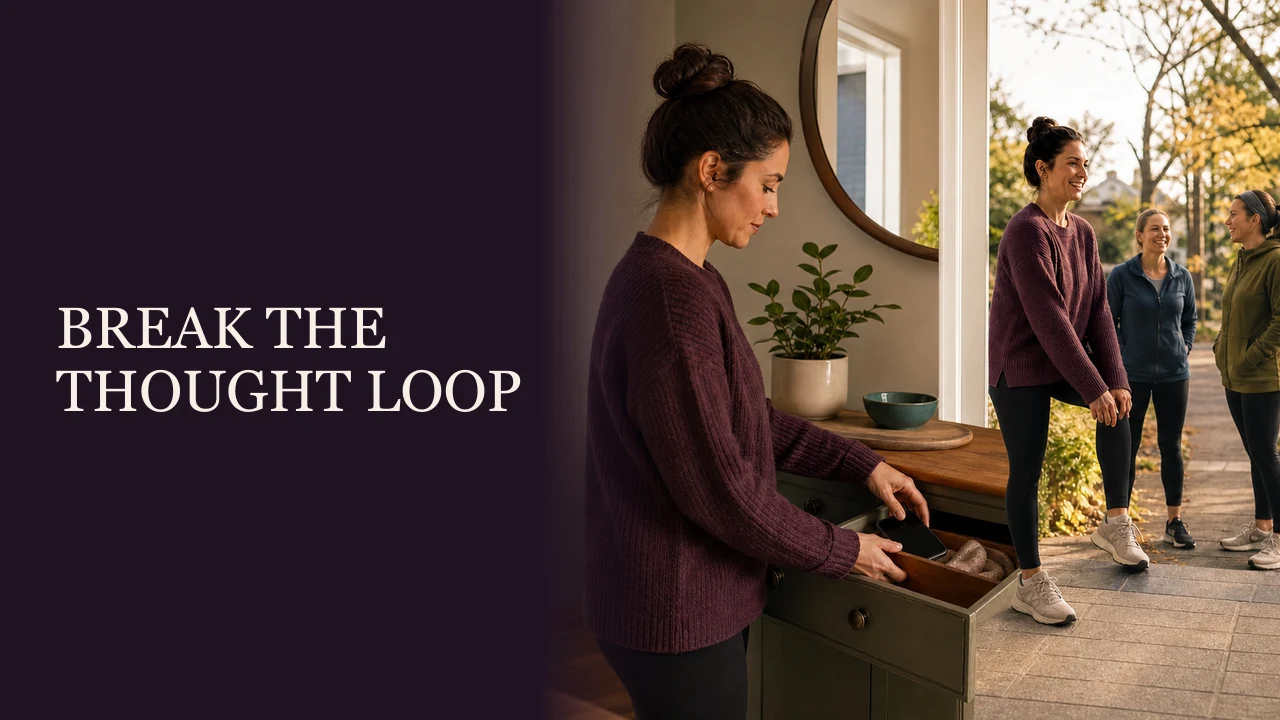
Obsession feeds on intermittent hope, fantasy, and repeated cues; recovery requires distance and a return to present reality.

The angle
Obsession feeds on intermittent hope, fantasy, and repeated cues; recovery requires distance and a return to present reality.
- Remove the digital rituals that restart the loop.
- Name what the fantasy provides emotionally.
- Fill the empty structure with people, movement, and purposeful attention.
Watch or listen
How to Stop Obsessing Over Someone and Take Your Attention Back
Mira and Jules unpack the signals that create warmth, possibility, and mutual momentum without making flirting feel like a performance.
35 minute companion conversation
This episode uses fictional AI-generated digital hosts. The script and final publication are reviewed by Enchantment Dating.
Accept what has ended: what how to stop obsessing over someone is really asking
When women search for how to stop obsessing over someone, the surface question often hides a deeper one: how to move toward love without losing perspective. Looking at meeting the actual loss instead of negotiating endlessly with the imagined future gives you something sturdier than a script. You can notice what is happening, choose a proportionate response, and leave room for him to participate. Obsession feeds on intermittent hope, fantasy, and repeated cues; recovery requires distance and a return to present reality. That cannot guarantee his answer, because healthy dating includes another person's agency. It can replace guesswork with clarity while keeping warmth, humor, and hope intact.
Remove the digital rituals that restart the loop. Turn that idea into behavior by choosing the smallest honest move that fits the moment. You might ask a direct question, make a simple invitation, name a preference, or wait long enough to see whether he contributes. Check whether the move expresses you or attempts to control his answer. The first builds intimacy; the second usually builds anxiety. A grounded approach to how to stop obsessing over someone leaves both people freer to be clear, which is what makes a promising connection easier to trust.
Name what the fantasy provides emotionally. Your nervous system provides information, although it needs interpretation. Excitement can feel buzzy, uncertainty can feel intoxicating, and safety can initially feel quieter. Notice whether contact leaves you mostly curious and grounded or repeatedly confused and depleted. Then compare that feeling with his observable behavior. Neither intuition nor a checklist should stand alone. Together, they show whether how to stop obsessing over someone is creating genuine closeness, temporary validation, or a chase that asks too much of you.
Fill the empty structure with people, movement, and purposeful attention. Try one experiment connected to meeting the actual loss instead of negotiating endlessly with the imagined future. Choose a real situation this week, decide beforehand what grounded behavior would look like, and observe the result without grading your personality. Write down what happened before adding an interpretation. Then ask whether you feel clearer, more connected, and more respected. This turns how to stop obsessing over someone into a learnable skill. Progress may be a warmer exchange, a direct answer, a boundary kept, or relief that a particular connection is not right for you. Each outcome gives you useful information.
Stabilize the first days
When women search for how to stop obsessing over someone, the surface question often hides a deeper one: how to move toward love without losing perspective. Looking at supporting sleep, food, movement, work, and contact with trusted people gives you something sturdier than a script. You can notice what is happening, choose a proportionate response, and leave room for him to participate. Obsession feeds on intermittent hope, fantasy, and repeated cues; recovery requires distance and a return to present reality. That cannot guarantee his answer, because healthy dating includes another person's agency. It can replace guesswork with clarity while keeping warmth, humor, and hope intact.
Name what the fantasy provides emotionally. Slow the moment down enough to distinguish desire from urgency. Ask what you know directly, what you are assuming, and which action would provide useful information without asking you to abandon your dignity. Confidence is not maximal boldness; it is choosing a response that fits the evidence. Keep early steps light and reversible. In an established relationship, add context and honesty. The aim is staying connected to your judgment while remaining open to affection, surprise, and the possibility of being genuinely met.
Fill the empty structure with people, movement, and purposeful attention. Reciprocity is the clearest reality check. Healthy connection moves in both directions: questions are returned, plans receive answers, care is noticed, boundaries are respected, and awkward moments can be repaired. One quiet interaction cannot tell you everything, especially when someone is shy, busy, or nervous. Repeated patterns tell you much more. If you continually translate silence into hidden devotion or supply all the momentum yourself, pause. More effort from you cannot reveal effort from him. Space is not a tactic here; it is how reality becomes visible.
Remove the digital rituals that restart the loop. Try one experiment connected to supporting sleep, food, movement, work, and contact with trusted people. Choose a real situation this week, decide beforehand what grounded behavior would look like, and observe the result without grading your personality. Write down what happened before adding an interpretation. Then ask whether you feel clearer, more connected, and more respected. This turns how to stop obsessing over someone into a learnable skill. Progress may be a warmer exchange, a direct answer, a boundary kept, or relief that a particular connection is not right for you. Each outcome gives you useful information.
Create enough distance
There is no single move that settles how to stop obsessing over someone, but there is a reliable way to think about it. Begin with using contact limits and digital boundaries to let the nervous system settle. Separate what you observed from what you hoped, feared, or inferred, then choose a calm next step that can reveal more. Obsession feeds on intermittent hope, fantasy, and repeated cues; recovery requires distance and a return to present reality. This protects romance from becoming a performance review. Attraction stays alive while behavior, time, and mutual effort are given enough room to show what the connection can actually support.
Fill the empty structure with people, movement, and purposeful attention. Slow the moment down enough to distinguish desire from urgency. Ask what you know directly, what you are assuming, and which action would provide useful information without asking you to abandon your dignity. Confidence is not maximal boldness; it is choosing a response that fits the evidence. Keep early steps light and reversible. In an established relationship, add context and honesty. The aim is staying connected to your judgment while remaining open to affection, surprise, and the possibility of being genuinely met.
Remove the digital rituals that restart the loop. Your nervous system provides information, although it needs interpretation. Excitement can feel buzzy, uncertainty can feel intoxicating, and safety can initially feel quieter. Notice whether contact leaves you mostly curious and grounded or repeatedly confused and depleted. Then compare that feeling with his observable behavior. Neither intuition nor a checklist should stand alone. Together, they show whether how to stop obsessing over someone is creating genuine closeness, temporary validation, or a chase that asks too much of you.
Name what the fantasy provides emotionally. A good next step should produce information as well as hope. Decide what you will do, what response would show reciprocal interest, and what boundary keeps the experiment proportionate. Then let the result be real. Success is not limited to getting the romantic answer you wanted. It can also be discovering compatibility, hearing a clear no, noticing a warning sign sooner, or speaking in a way that makes you proud. That definition of progress makes how to stop obsessing over someone less frightening and more useful.
Grieve the whole story
When women search for how to stop obsessing over someone, the surface question often hides a deeper one: how to move toward love without losing perspective. Looking at making room for love, anger, relief, humiliation, hope, and disappointment gives you something sturdier than a script. You can notice what is happening, choose a proportionate response, and leave room for him to participate. Obsession feeds on intermittent hope, fantasy, and repeated cues; recovery requires distance and a return to present reality. That cannot guarantee his answer, because healthy dating includes another person's agency. It can replace guesswork with clarity while keeping warmth, humor, and hope intact.
Remove the digital rituals that restart the loop. Turn that idea into behavior by choosing the smallest honest move that fits the moment. You might ask a direct question, make a simple invitation, name a preference, or wait long enough to see whether he contributes. Check whether the move expresses you or attempts to control his answer. The first builds intimacy; the second usually builds anxiety. A grounded approach to how to stop obsessing over someone leaves both people freer to be clear, which is what makes a promising connection easier to trust.
Name what the fantasy provides emotionally. Look for his contribution instead of grading only your delivery. Does he become curious about you, remember details, follow through, and make the interaction easier to continue? Mutuality can be imperfect around nerves, but it should become clearer over time. If every explanation for his passivity has to be invented by you, fantasy is supplying more than the relationship. Let patterns outrank potential. That keeps how to stop obsessing over someone connected to an actual person rather than an imagined future.
Fill the empty structure with people, movement, and purposeful attention. Try one experiment connected to making room for love, anger, relief, humiliation, hope, and disappointment. Choose a real situation this week, decide beforehand what grounded behavior would look like, and observe the result without grading your personality. Write down what happened before adding an interpretation. Then ask whether you feel clearer, more connected, and more respected. This turns how to stop obsessing over someone into a learnable skill. Progress may be a warmer exchange, a direct answer, a boundary kept, or relief that a particular connection is not right for you. Each outcome gives you useful information. The same judgment becomes useful when thinking about how to heal after romantic rejection.
Interrupt obsessive loops in your own voice
When women search for how to stop obsessing over someone, the surface question often hides a deeper one: how to move toward love without losing perspective. Looking at redirecting rumination through structure, grounding, writing, and reality-based reminders gives you something sturdier than a script. You can notice what is happening, choose a proportionate response, and leave room for him to participate. Obsession feeds on intermittent hope, fantasy, and repeated cues; recovery requires distance and a return to present reality. That cannot guarantee his answer, because healthy dating includes another person's agency. It can replace guesswork with clarity while keeping warmth, humor, and hope intact.
Name what the fantasy provides emotionally. The practical test is proportion. A new match has not earned the emotional weight of a committed partner, and a long-term partner deserves more context than a stranger. Match your openness, effort, and expectations to the relationship that exists today. This prevents fantasy from racing ahead of evidence without making you cold. You can feel excited and still ask whether the interaction is becoming more mutual, more respectful, and more real as it develops.
Fill the empty structure with people, movement, and purposeful attention. Your nervous system provides information, although it needs interpretation. Excitement can feel buzzy, uncertainty can feel intoxicating, and safety can initially feel quieter. Notice whether contact leaves you mostly curious and grounded or repeatedly confused and depleted. Then compare that feeling with his observable behavior. Neither intuition nor a checklist should stand alone. Together, they show whether how to stop obsessing over someone is creating genuine closeness, temporary validation, or a chase that asks too much of you.
Remove the digital rituals that restart the loop. Try one experiment connected to redirecting rumination through structure, grounding, writing, and reality-based reminders. Choose a real situation this week, decide beforehand what grounded behavior would look like, and observe the result without grading your personality. Write down what happened before adding an interpretation. Then ask whether you feel clearer, more connected, and more respected. This turns how to stop obsessing over someone into a learnable skill. Progress may be a warmer exchange, a direct answer, a boundary kept, or relief that a particular connection is not right for you. Each outcome gives you useful information.
Separate rejection from worth
How to Stop Obsessing Over Someone is a skill you can practice without performing a new personality. Focus here on understanding that an ending describes a relationship, not your human value. The useful question is not how to guarantee the outcome, but what you can notice and choose. Dating cannot offer certainty on demand, yet it can reveal attraction, character, timing, and reciprocity. Obsession feeds on intermittent hope, fantasy, and repeated cues; recovery requires distance and a return to present reality. Treat that principle as a compass. It should make you more observant and more recognizably yourself, not more anxious about executing every detail perfectly.
Fill the empty structure with people, movement, and purposeful attention. Slow the moment down enough to distinguish desire from urgency. Ask what you know directly, what you are assuming, and which action would provide useful information without asking you to abandon your dignity. Confidence is not maximal boldness; it is choosing a response that fits the evidence. Keep early steps light and reversible. In an established relationship, add context and honesty. The aim is staying connected to your judgment while remaining open to affection, surprise, and the possibility of being genuinely met.
Remove the digital rituals that restart the loop. Look for his contribution instead of grading only your delivery. Does he become curious about you, remember details, follow through, and make the interaction easier to continue? Mutuality can be imperfect around nerves, but it should become clearer over time. If every explanation for his passivity has to be invented by you, fantasy is supplying more than the relationship. Let patterns outrank potential. That keeps how to stop obsessing over someone connected to an actual person rather than an imagined future.
Name what the fantasy provides emotionally. Give yourself a simple practice: name one thing you can control, one thing you can communicate, and one thing only time or his behavior can answer. Act on the first two and stop trying to manufacture the third. Afterward, review the moment with compassion rather than embarrassment. What felt natural? What became clearer? Learning how to stop obsessing over someone is not about never feeling awkward. It is about recovering quickly and choosing people with whom honesty creates more closeness rather than punishment.
Learn without blaming yourself
How to Stop Obsessing Over Someone is a skill you can practice without performing a new personality. Focus here on taking useful responsibility while refusing shame for another person's choices. The useful question is not how to guarantee the outcome, but what you can notice and choose. Dating cannot offer certainty on demand, yet it can reveal attraction, character, timing, and reciprocity. Obsession feeds on intermittent hope, fantasy, and repeated cues; recovery requires distance and a return to present reality. Treat that principle as a compass. It should make you more observant and more recognizably yourself, not more anxious about executing every detail perfectly.
Remove the digital rituals that restart the loop. Slow the moment down enough to distinguish desire from urgency. Ask what you know directly, what you are assuming, and which action would provide useful information without asking you to abandon your dignity. Confidence is not maximal boldness; it is choosing a response that fits the evidence. Keep early steps light and reversible. In an established relationship, add context and honesty. The aim is staying connected to your judgment while remaining open to affection, surprise, and the possibility of being genuinely met.
A real conversation where timing, tone, and mutual interest are still unfolding. In that setting, how to stop obsessing over someone is not an abstract formula. It is a series of small choices: what you notice, how directly you speak, whether he responds, and whether you still feel like yourself afterward. Use the scene as a reality check. Advice is valuable only when it survives interruptions, imperfect timing, and another person's freedom to respond in his own way.
Name what the fantasy provides emotionally. Reciprocity is the clearest reality check. Healthy connection moves in both directions: questions are returned, plans receive answers, care is noticed, boundaries are respected, and awkward moments can be repaired. One quiet interaction cannot tell you everything, especially when someone is shy, busy, or nervous. Repeated patterns tell you much more. If you continually translate silence into hidden devotion or supply all the momentum yourself, pause. More effort from you cannot reveal effort from him. Space is not a tactic here; it is how reality becomes visible.
Fill the empty structure with people, movement, and purposeful attention. A good next step should produce information as well as hope. Decide what you will do, what response would show reciprocal interest, and what boundary keeps the experiment proportionate. Then let the result be real. Success is not limited to getting the romantic answer you wanted. It can also be discovering compatibility, hearing a clear no, noticing a warning sign sooner, or speaking in a way that makes you proud. That definition of progress makes how to stop obsessing over someone less frightening and more useful.
Rebuild identity and routine
There is no single move that settles how to stop obsessing over someone, but there is a reliable way to think about it. Begin with returning energy to friendship, purpose, home, pleasure, and personal plans. Separate what you observed from what you hoped, feared, or inferred, then choose a calm next step that can reveal more. Obsession feeds on intermittent hope, fantasy, and repeated cues; recovery requires distance and a return to present reality. This protects romance from becoming a performance review. Attraction stays alive while behavior, time, and mutual effort are given enough room to show what the connection can actually support.
Name what the fantasy provides emotionally. The practical test is proportion. A new match has not earned the emotional weight of a committed partner, and a long-term partner deserves more context than a stranger. Match your openness, effort, and expectations to the relationship that exists today. This prevents fantasy from racing ahead of evidence without making you cold. You can feel excited and still ask whether the interaction is becoming more mutual, more respectful, and more real as it develops. This is easier to practice when you also understand how to handle romantic rejection with confidence.
Fill the empty structure with people, movement, and purposeful attention. Look for his contribution instead of grading only your delivery. Does he become curious about you, remember details, follow through, and make the interaction easier to continue? Mutuality can be imperfect around nerves, but it should become clearer over time. If every explanation for his passivity has to be invented by you, fantasy is supplying more than the relationship. Let patterns outrank potential. That keeps how to stop obsessing over someone connected to an actual person rather than an imagined future.
Remove the digital rituals that restart the loop. A good next step should produce information as well as hope. Decide what you will do, what response would show reciprocal interest, and what boundary keeps the experiment proportionate. Then let the result be real. Success is not limited to getting the romantic answer you wanted. It can also be discovering compatibility, hearing a clear no, noticing a warning sign sooner, or speaking in a way that makes you proud. That definition of progress makes how to stop obsessing over someone less frightening and more useful.
Recognize genuine readiness
How to Stop Obsessing Over Someone is a skill you can practice without performing a new personality. Focus here on looking for curiosity and steadiness rather than using dating to numb pain. The useful question is not how to guarantee the outcome, but what you can notice and choose. Dating cannot offer certainty on demand, yet it can reveal attraction, character, timing, and reciprocity. Obsession feeds on intermittent hope, fantasy, and repeated cues; recovery requires distance and a return to present reality. Treat that principle as a compass. It should make you more observant and more recognizably yourself, not more anxious about executing every detail perfectly.
Fill the empty structure with people, movement, and purposeful attention. Slow the moment down enough to distinguish desire from urgency. Ask what you know directly, what you are assuming, and which action would provide useful information without asking you to abandon your dignity. Confidence is not maximal boldness; it is choosing a response that fits the evidence. Keep early steps light and reversible. In an established relationship, add context and honesty. The aim is staying connected to your judgment while remaining open to affection, surprise, and the possibility of being genuinely met.
Remove the digital rituals that restart the loop. Look for his contribution instead of grading only your delivery. Does he become curious about you, remember details, follow through, and make the interaction easier to continue? Mutuality can be imperfect around nerves, but it should become clearer over time. If every explanation for his passivity has to be invented by you, fantasy is supplying more than the relationship. Let patterns outrank potential. That keeps how to stop obsessing over someone connected to an actual person rather than an imagined future.
Name what the fantasy provides emotionally. Try one experiment connected to looking for curiosity and steadiness rather than using dating to numb pain. Choose a real situation this week, decide beforehand what grounded behavior would look like, and observe the result without grading your personality. Write down what happened before adding an interpretation. Then ask whether you feel clearer, more connected, and more respected. This turns how to stop obsessing over someone into a learnable skill. Progress may be a warmer exchange, a direct answer, a boundary kept, or relief that a particular connection is not right for you. Each outcome gives you useful information.
Your next step with how to stop obsessing over someone
When women search for how to stop obsessing over someone, the surface question often hides a deeper one: how to move toward love without losing perspective. Looking at turning the experience into clearer standards and a more compassionate future gives you something sturdier than a script. You can notice what is happening, choose a proportionate response, and leave room for him to participate. Obsession feeds on intermittent hope, fantasy, and repeated cues; recovery requires distance and a return to present reality. That cannot guarantee his answer, because healthy dating includes another person's agency. It can replace guesswork with clarity while keeping warmth, humor, and hope intact.
Remove the digital rituals that restart the loop. Turn that idea into behavior by choosing the smallest honest move that fits the moment. You might ask a direct question, make a simple invitation, name a preference, or wait long enough to see whether he contributes. Check whether the move expresses you or attempts to control his answer. The first builds intimacy; the second usually builds anxiety. A grounded approach to how to stop obsessing over someone leaves both people freer to be clear, which is what makes a promising connection easier to trust.
Name what the fantasy provides emotionally. Reciprocity is the clearest reality check. Healthy connection moves in both directions: questions are returned, plans receive answers, care is noticed, boundaries are respected, and awkward moments can be repaired. One quiet interaction cannot tell you everything, especially when someone is shy, busy, or nervous. Repeated patterns tell you much more. If you continually translate silence into hidden devotion or supply all the momentum yourself, pause. More effort from you cannot reveal effort from him. Space is not a tactic here; it is how reality becomes visible.
Fill the empty structure with people, movement, and purposeful attention. Give yourself a simple practice: name one thing you can control, one thing you can communicate, and one thing only time or his behavior can answer. Act on the first two and stop trying to manufacture the third. Afterward, review the moment with compassion rather than embarrassment. What felt natural? What became clearer? Learning how to stop obsessing over someone is not about never feeling awkward. It is about recovering quickly and choosing people with whom honesty creates more closeness rather than punishment.
Podcast companion
Enchantment Roundtable: How to Stop Obsessing Over Someone
Two women unpack the article with real-life examples, disagreement where it helps, and practical next steps you can try this week.
35 minute conversation
Hosted by Mira and Jules · Show page ready for audio embed
Continue reading
Recommended next
Healing
How to Get Over a Breakup
Getting over a breakup means building a life that no longer organizes itself around the lost relationship.
Healing
How to Heal After Romantic Rejection
Rejection hurts because hope and belonging matter; healing begins when the answer stops defining your worth.
Healing
How to Recover After Betrayal
Recovery after betrayal is the slow restoration of reality, safety, agency, and trust in your own perception.
Weekly dating letter
Get one steadier idea for your dating life each week.
A short note with practical prompts, reader questions, and the newest Enchantment Dating guides.
Community
Comments
Share a thoughtful note, a question, or a perspective that adds to the conversation.
Be the first to add a thoughtful note.